


Friends,
We have family company this week, so I’m taking a break and sending you one of my favorite LifeScapes posts, first published in 2023. Much of what I wrote here is still very true, and although Molly left us nearly a year ago, her fur is still with us, an occasional loving reminder of her years in this house. (People who live with dogs will understand.)
If you’re new here, the About page on my Substack will tell you more about Thyme, Place & Story, and what to look for during the month. If you’ve been around for a while or if you’re a long-term reader of my books, thank you for your friendship and support. You are all deeply appreciated!

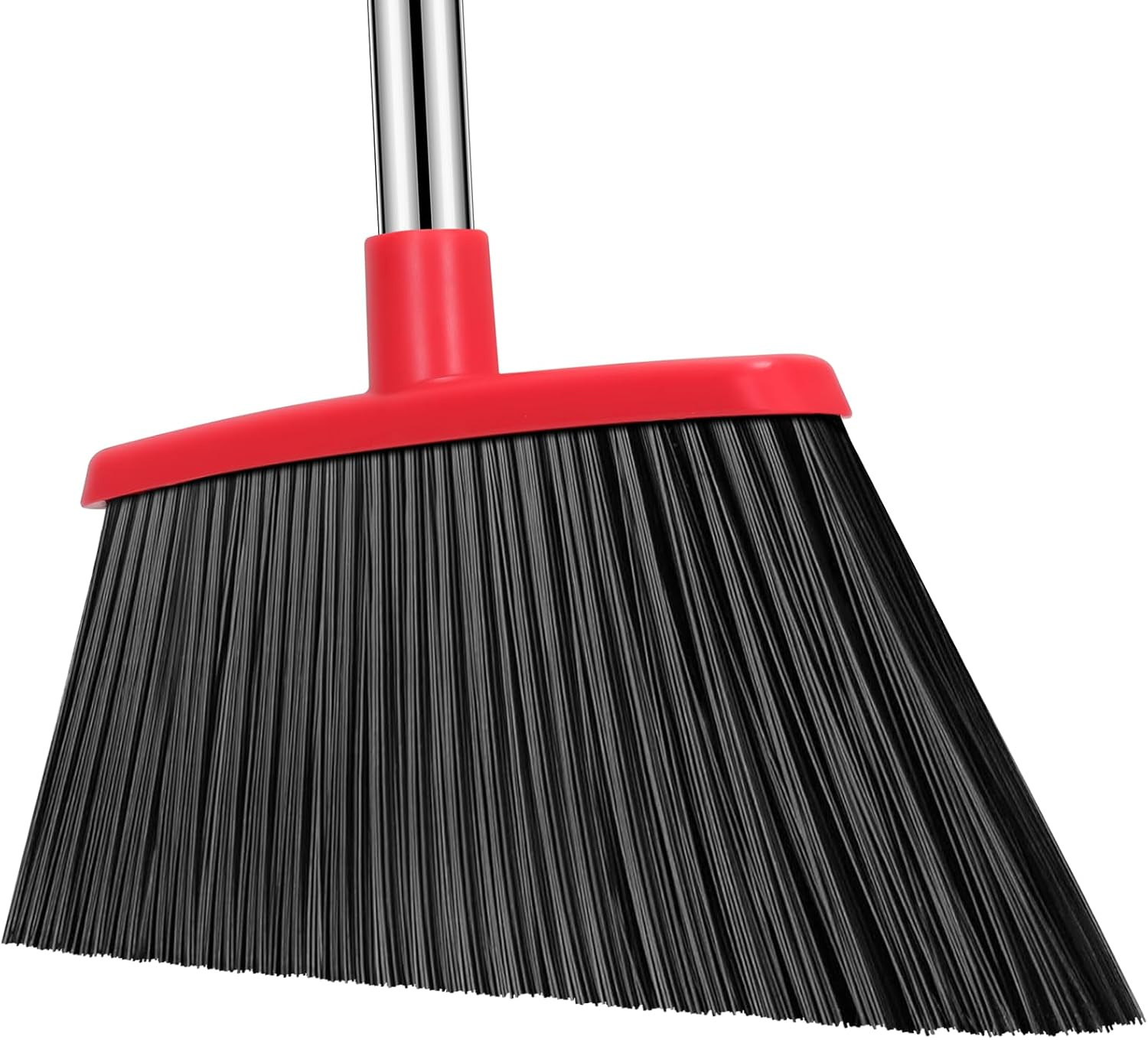
I have a new broom.
I bought this one because it was cheap (the only broom under ten dollars on the catalog page), but also because its bristles are unflagged. That is, the bristle-ends are blunt-cut. This is an entirely new concept to me but it turns out to be really important when it comes to sweeping up the Molly-fur our senior puppy discards everywhere. I recently learned that my previous broom (for which I paid exactly twice as much) has flagged bristles with frayed ends, which is why they attach themselves so gaily to all that fuzzy Molly fur and will only let it go when I pull it off. My new, inexpensive unflagged broom, on the other hand, behaves the way a broom ought to behave. It does not cling to Molly’s castoff fur. Sweeping with it is an extraordinary pleasure.
Which makes me ask, with some exasperation, how I reached my advanced age without realizing that there is a difference between flagged and unflagged bristles. After all, I’ve been sweeping up after one disaster or another since I was old enough to take the broom my mother handed me, along with the implied instruction that this is what a woman does with her life.
My outsized pleasure in this very small thing has prompted several even larger and more troublesome questions. Has my senior life out here in rural Texas contracted to such narrow dimensions that I can be thrilled—honestly thrilled, no understatement—with a broom that manages to sweep clean?
Have my 85-year-old horizons now shrunk to the thirty-by-forty footprint of my small house? Am I contenting myself with minor trivialities, to the detriment of the Next Big Thing?
And how would my younger self—at forty, say, still climbing the academic career ladder—have reacted to this old woman’s delight in a few unflagged bristles? Or at forty-five, when she was making a plan to jump off? The ladder, that is.
But maybe, by forty-five, she might have understood. This new broom isn’t that far removed from the reasons Bill and I married and left our career-culture jobs. We both wanted a smaller world, a less complicated social life, fewer politics in our work, fewer distractions, fewer consumables, conspicuously less consumption.
Fueling this concern for the small were three books I had recently read: Diet for a Small Planet (Frances Moore Lappé); Overshoot: The Ecological Basis of Revolutionary Change (William R. Catton); and Small Is Beautiful: Economics as if People Mattered (E. F. Schumacher). I wanted a smaller life, downsized to fit the smaller planet we occupy and the smaller world I had begun to imagine, built out of significantly less stuff, and built on the significantly smaller paychecks that writers earn. I wanted the kind of life that poet Maxine Kumin had in mind in Always Beginning: Essays on a Life in Poetry:
I am grateful for every ordinary day, knowing that these will draw to a close somewhere beyond our seeing. I hope to go on picking vegetables, pulling bindweed out of the fields, enjoying the birds, the dogs, even our elderly cat, whose last season this likely will be . . . Going on is, after all, the ultimate pleasure of our lives.
So in that year—1987, in the spring—we moved to the five Hill Country acres that Bill had bought in 1974, an hour’s drive outside of Austin. Using savings, we purchased a much-used single-wide, hooked up to the electric grid, and installed a DIY road, a septic system and a well. In 1995, we upgraded to a new doublewide and and bought another twenty-six acres, to save it from development.
Over the nearly forty years we’ve been here, we’ve been joined by sheep, cows, chickens, geese, ducks, and peafowl as well as the dogs and cats who have arrived, unbidden. The books weren’t a goldmine but as long as we were careful, they earned enough to pay for the land and what’s on it and in it and support us and our flocks.
(The fact that we don’t use credit is largely owing to the man I married, who once held up a two-by-four with the offhand remark, “The cost of a two-by-two and a two-by-four is roughly the same, so if you cut this down the middle you can double your money.”)
Of course, it all takes work—a lot of it—and some pretty large dreams. The books don’t write themselves, the dead-and-down trees have to get turned into firewood, the animals demand attention, the road needs repair. Then it’s planting (or plowing or weeding or harvesting) season in the garden. Or fire season and the grass has to be kept short. Or winter and the livestock and birds need protection.
Meanwhile, the traffic noise from the highway gets louder; the urban subdivisions, amoeba-like, creep closer; and climate change turns up the the global thermostat another notch, making every summer a few degrees hotter than the summer before. Our television and computers require feeding from their satellite dishes, and there’s even rumor of fiber-optic a few miles up the road. The world out there is busy using up the planet’s resources in a big way, with little thought given to living lightly.
That’s why my new broom brings me such extraordinary pleasure. I still dream big, but I keep trying to live small. I hope to go on sweeping up whatever fur bunnies our furred companion leave in the corners, enjoying the books I have the privilege of reading, appreciating the partner I’ve committed to living with, and being grateful for days that are filled with green leaves and nights with stars and a generous moon. If these ordinary pleasures aren’t enough, that’s just too bad, because this space, this time, is what I have.
And it’s more than enough for a large life.

Your turn. Is there a difference, for you, between dreaming big and living small? What are the small things that have brought you large pleasures—sometimes surprisingly? How has this changed over the course of your life? Is this something you think about a lot—or would rather not think about it at all? I’d love to hear your thoughts. And there are no wrong answers.
The Dahlias and I will be here on Thursday May 21, with Week Three of our ten-week slow-read of The Darling Dahlias and the Cucumber Tree. You can review all the details here. Our conversation (in the comments) always turns up new ways to read and understand books like these and the work of writers, agents, editors, publishers, and the network of producers, distributors, retailers, and marketers that keeps books circulating through our communities. Please bring your questions and join us!
Your post inspired me to share my thoughts on weeds - specifically bindweeds.
This morning I looked out at my perennial garden and saw my neighbor's bindweed had climbed to the top of the chain link fence separating our properties. It is sending a long arm out to breach the perimeter and latch on to my plants.
Bindweed is a metaphor. It is invasive and will kill what it smothers. I yank it our with pleasure knowing it will wither and die. For me it is a way to fight back on what invades my thoughts. My neighbor gave up on trying to eradicate it because "you have to get down to the roots." Fortunately I know that a plant needs sun to grow and if it has no leaves it will eventually die, roots and all.
We can do something to take control before we are bound up and smothered. Pulling weeds is very satisfying!
A broom, a magical broom! You can fly with your imagination and sweep with a keen eye, Susan!